Particle (Basic ㊦ 247)
A particle which indicates that a proposition about the preceeding element X is also true when another similar proposition is true.
Equivalent: Too; also; (not) ~ either
| (i) Noun も | 私も | I, too/me (as direct object), too |
| (ii) Noun (particle) も | 日本(に)も | In/to Japan, too |
| アメリカ(へ)も | To America too | |
| (iii) Noun Particle も | 先生にも | To/for the teacher, too (indirect object) |
| フランスからも | From France | |
| イギリスでも | In England, too | |
| 友達とも | With my friend, too |
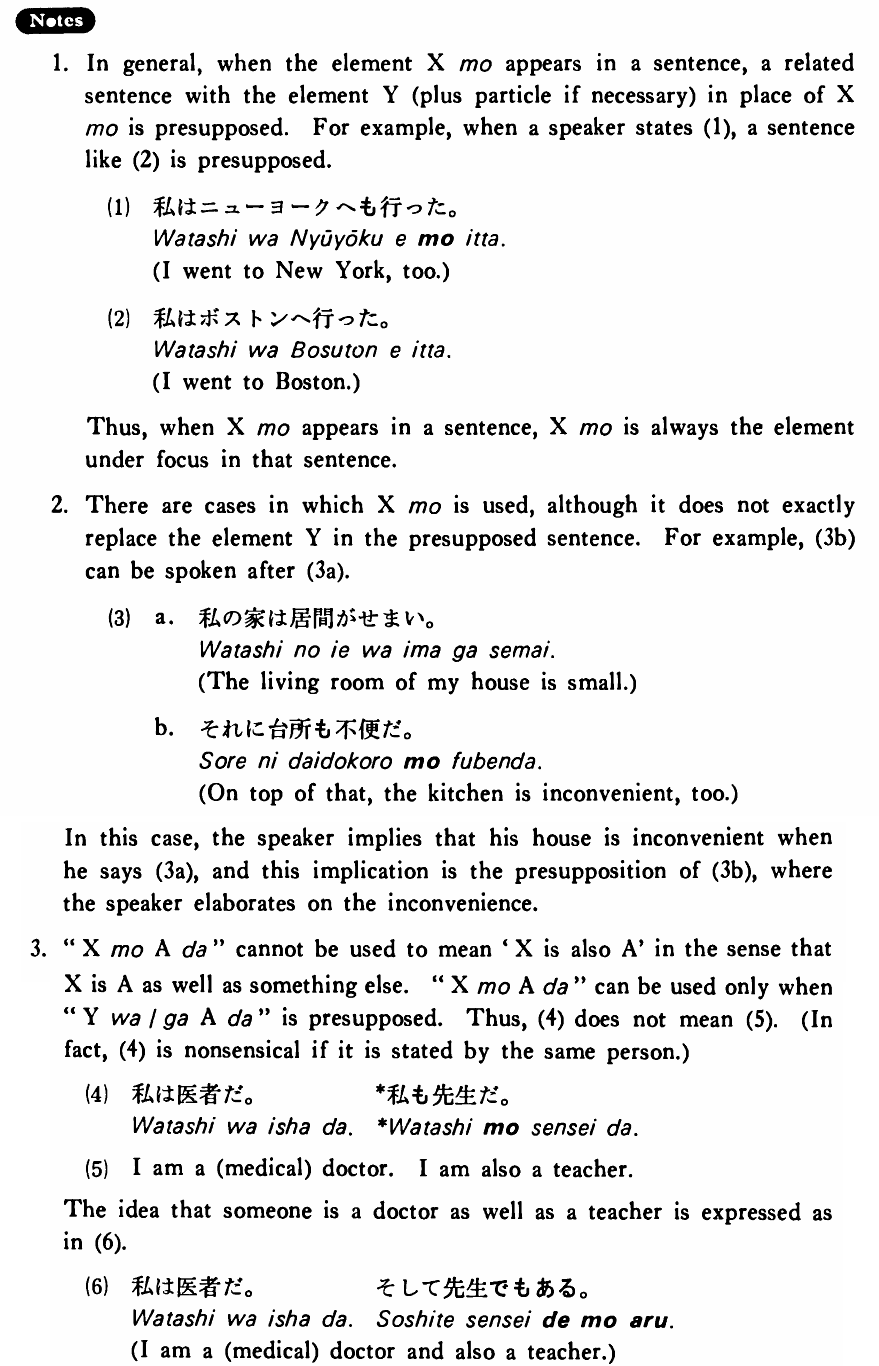
1. In general, when the element Xも appears in a sentence, a related sentence with the element Y (plus particle if necessary) in place of Xも is presupposed. For example, when a speaker states (1), a sentence like (2) is presupposed.
Thust when Xも appears in a sentence, Xも is always the element under focus in that sentence.
2. There are cases in which Xも is used, althougn it does not exactly replace the element Y in the presupposed sentence. For example, (3b) can be spoken after (3a).
In this case, the speaker implies that his house is inconvenient when he says (3a), and this implication is the presupposition of (3b), where the speaker elaborates on the inconvenience.
3. "XもAだ" cannot be used to mean 'X is also A' in the sense that X is A as well as something else. "XもAだ" can be used only when "Yは/がAだ" presupposed. Thus, (4) does not mean (5). (In fact, (4) is nonsensical if it is stated by the same person.)
The idea that someone is a doctor as well as a teacher is expressed as in (6).